Why Dancing Is Genuinely Good for Your Mental Health
 Therapy SoundField notes
You don’t need a diagnosis, a bad week, or a breakup to justify dancing. But if you’ve ever left a dance floor feeling lighter than you walked in, that wasn’t a coincidence — and it wasn’t just the music.
The quick version: dancing helps your mental health because it combines three things your mind rarely gets at once — physical release, social connection without the pressure of talking, and a steady rhythm that gives your nervous system something predictable to hold onto. It’s not therapy, and we’re not claiming it fixes anything. But it’s a real, low-barrier practice that does something gyms, apps and even conversations often can’t.
The floor is not a gym
It’s tempting to file dancing under “exercise” and leave it there. But a treadmill and a dance floor ask very different things of you. One is about output — calories, reps, pace. The other is about expression. Nobody’s counting your steps on the floor. You’re not optimising anything. You’re just responding, in real time, to a sound that’s already decided how it wants you to feel.
That distinction matters. Exercise for the sake of metrics can become one more thing to manage. Dancing, done right, asks for the opposite — letting go of management entirely.
Your body knows before your mind does
Most of us live in our heads most of the day — thinking about the thing we said, the thing we have to do, the thing we’re avoiding. Dancing pulls you the other way. It asks you to notice your body: the weight shifting between your feet, the heat building in your chest, the exact moment a bassline lands in your sternum.
That shift from thinking to sensing has a name — interoception, or bodily awareness — and it’s one of the quiet reasons dancing feels like release even when nothing’s been “solved.” You’re not thinking your way out of a mood. You’re moving your way through it.
Moving with strangers does something talking can’t
There’s a particular kind of loneliness that isn’t about being alone — it’s about being surrounded by people and still feeling unseen. Dancing in a crowd works against that in a strange, almost backwards way: you don’t need to know anyone’s name to feel connected to them.
Researchers call this effect behavioural synchrony — the sense of trust and closeness that builds when bodies move in time, even without words. It’s why a room full of strangers can feel more like community than a dinner party full of small talk. The floor asks nothing of you socially except presence.
You don’t need to know anyone’s name to feel like you belong to the room.
The anonymity-intimacy paradox
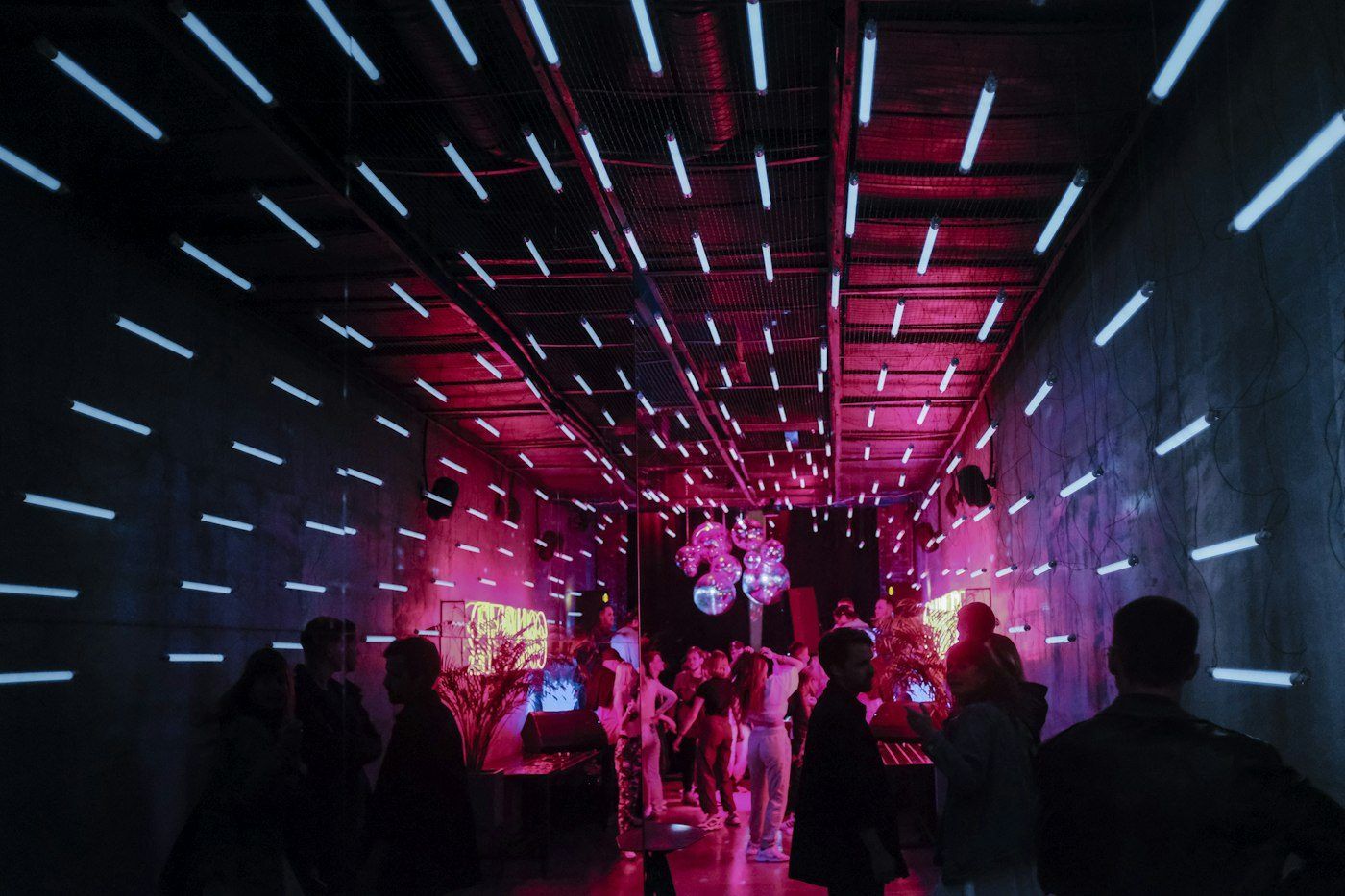
Dark rooms, low light, a crowd that isn’t watching you — it sounds like the opposite of connection, but it’s actually what makes connection possible for a lot of people. Social anxiety thrives on scrutiny. The dance floor removes it. Nobody’s evaluating your dancing. Nobody can hear what you’d say even if you tried. What’s left is pure, low-stakes presence — which, paradoxically, is often when people feel closest to others.
It’s part of why so many people describe the floor as one of the only places they feel “normal.” Not because they’re performing normalcy — because nobody’s asking them to.
Rhythm gives your nervous system something to hold
Anxious minds often spiral because there’s no external structure to anchor to — just thoughts, looping. A four-on-the-floor kick drum is the opposite of that. It’s steady, predictable, and happening right now, in your body, whether your mind cooperates or not.
That steadiness is regulating in a very literal sense. Your breathing tends to sync with tempo. Your shoulders drop. You stop bracing for the next thought and start following the next beat instead. It’s not magic — it’s entrainment, the same principle that makes a metronome useful in physio clinics. House music just happens to be an exceptionally good delivery system for it.
What actually gets processed out there
Ask around and you’ll hear the same stories in different words — the floor as the place where something finally moved, even if nothing was said out loud.
- Grief. Dancing gives sadness somewhere to go that isn’t a conversation you’re not ready to have.
- Burnout. A body that’s been sitting and thinking all week finally gets to just move.
- Loneliness. Being near people without the performance pressure of small talk.
- Overthinking. There’s no room to spiral when your attention is on the next four bars.
- Joy you forgot you had access to. Sometimes it’s not heavy at all — sometimes it’s just remembering your body can feel good.
Making it part of your actual life
You don’t need to overhaul anything to get the benefit. Dancing doesn’t need to be a weekly ritual or a big night out to count — though it can be. What matters more is treating it as a legitimate practice, not a guilty indulgence.
Go on a hard week, not just a good one. Go without deciding in advance how long you’ll stay. Let the music do the organising, and let your body answer. The point was never to look a certain way out there — it was to feel something move.
Therapy Sound · Vancouver events
House, techno and live shows across the city
Frequently asked questions
Is dancing actually good for mental health, or is that just a feeling?
Both. There’s real research behind it — movement, rhythm and social synchrony all have measurable regulating effects — but the feeling itself, the lightness you notice afterward, is the part most people care about most.
Do I need to be a good dancer to get the benefit?
No. The mental health benefits come from moving and being present, not from how it looks. Nobody on the floor is judging your technique — most people are too busy feeling their own night.
Can dancing help with anxiety specifically?
Many people find it does, largely because steady rhythm gives the nervous system something predictable to follow, which can quiet the spiralling that anxiety often runs on. It’s not a cure, but it’s a genuinely useful tool.
Does dancing alone at home count the same as dancing on a floor?
It helps, but it’s different. Dancing with others adds the social-synchrony effect — the sense of connection that comes from moving in time with people around you — which solo dancing at home doesn’t fully replicate.
This is general information, not medical advice. If you’re struggling, please reach out to a mental health professional or support service.
Therapy Sound is Vancouver’s home for house. The music, the floor, and the culture around it.